TRL’s Sustainable Firewood Production Project
Introduction
For more than two decades, Tui’k Ruch’ Lew/Helping the Earth (TRL), a Guatemalan not-for-profit organization, has been working to reduce deforestation of communities around Lake Atitlan, Guatemala. Our approach has been to encourage the use of energy-efficient Q’aaq’ (fire in Tz’utujil Maya) stoves, which can reduce firewood consumption by up to 70%. Now, we wish to complete the circle by creating opportunities for Q’aaq’ stove owners to further reduce deforestation. We are developing an innovative agro-forestry project, the TRL Sustainable Firewood Production project for Q’aaq’ stove owners. TRL wants to assist families with stoves, who also own plots of land, to begin to grow their own firewood by interplanting their crops, ideally with native species. To move this project forward, we are seeking volunteer experts in agro-forestry who could help design the project.
Background
Towns surrounding Lake Atitlan are experiencing rapid population growth. As a result, the area is experiencing deforestation due to housing expansion and growing firewood consumption. Additionally, disturbing changes in weather patterns are causing food crop failures and, most recently, rampant inflation is reducing purchasing power and pushing more people into poverty.
Open cooking fires have been the method of food preparation for millennia among the Maya and are still used by around 70% of the Maya population around Lake Atitlan*. Families using our efficient Q’aaq’ stoves also use wood, but they benefit from a number of economic and health advantages. For example, families can easily gather their own wood or purchase a small amount daily without the major outlay necessary for a tank of propane or a monthly electric bill. Using Q’aaq’ stoves also protects the respiratory health of the families by eliminating smoke from the home, eliminating the possibility of burns by children falling into open fires, reducing the time or money spent on firewood, and, most importantly, reducing the consumption of firewood by some 70%. These families are helping protect the forests on the mountainous slopes surrounding the lake.
For over 20 years, TRL has had great success with encouraging families to replace the traditional open cooking fires, which produce noxious smoke and consume huge quantities of firewood, through the introduction of the Q’aaq’ stove. This durable, moveable, energy-efficient, cast-cement stove has been accepted by the Tz’utujil people in our communities because it preserves their traditional connection to fire and respects the hearth as the heart of the Maya home.
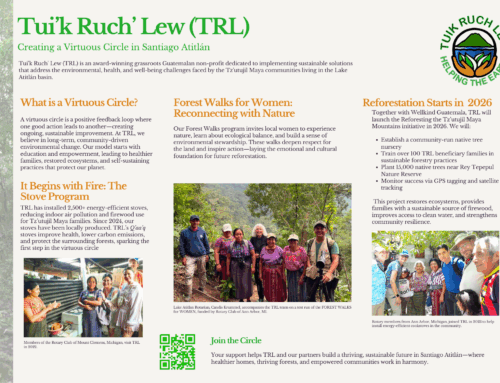
TRL makes sure families are able to fully adopt the new technology. Having witnessed many cookstove projects that simply install stoves and never return to see if they are being used correctly, we know that the full benefits of a cookstove cannot be realized without the intensive educational component we provide. Our tiny staff of 4 makes 5 home visits during the first year of stove use along with follow-up visits upon demand for the usual 10-year life of the stove. TRL has installed over 2,700 stoves, some of which are still functioning after 20 years of careful use and maintenance. Many are cherished in families where three generations have adopted the technology of the Q’aaq’ stove! Our stoves are produced in Santiago Atitlan by Tz’utujil builders, using high quality materials supplied by local businesses.
Next Steps
We would like to complete the circle, by providing families the opportunity to grow their own firewood. Families can interplant their crops with native species in such a way as to not reduce food crop production.
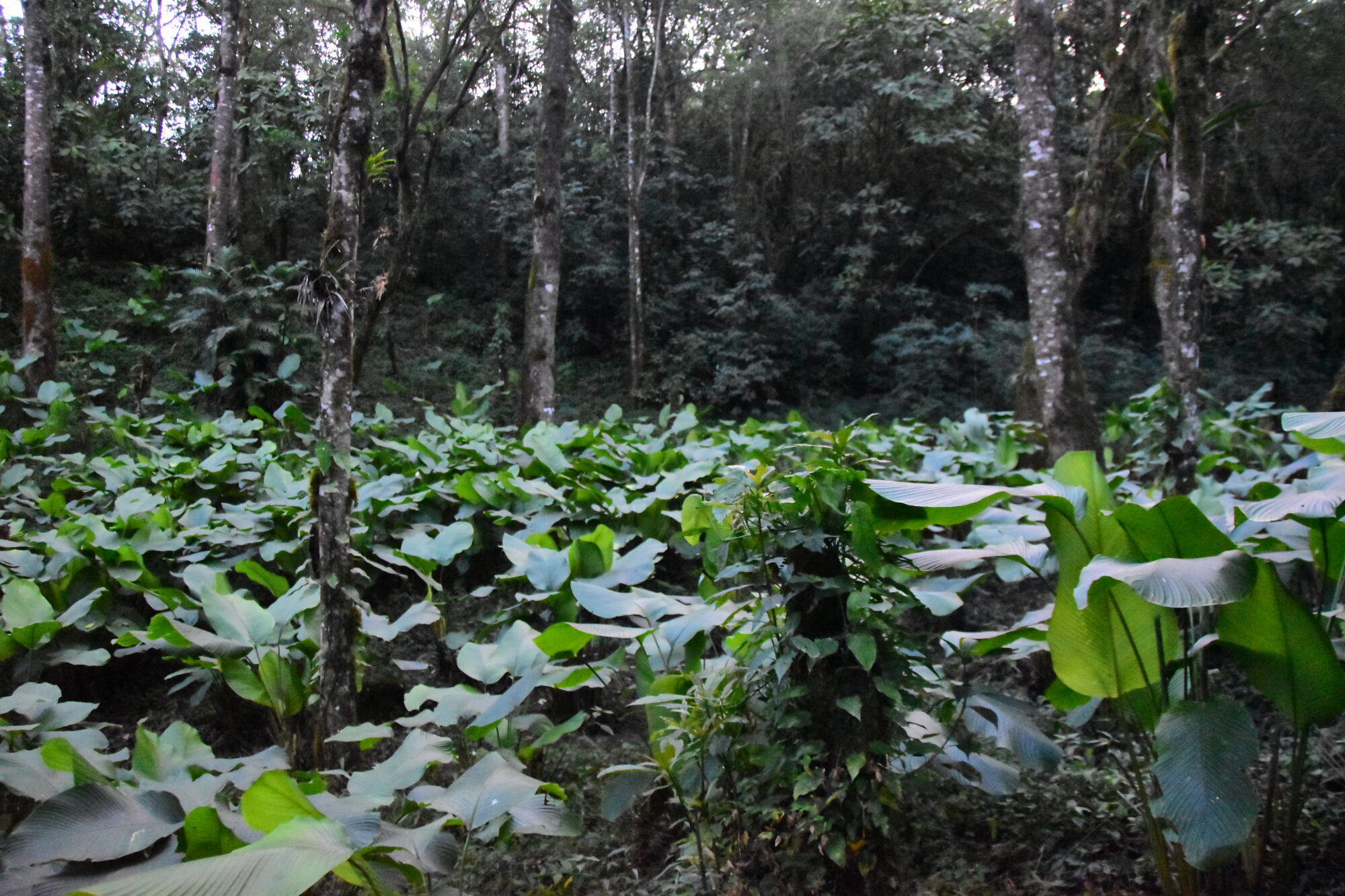
For example, plots may now contain plantings of Persea americana (Guatemalan “crillo” avocados) on the slopes of volcanos, shade-grown coffee, corn fields (“milpas”) planted along the lakeshore or plots of “maxan” (the indispensable leaves for wrapping tamales and other food in the Maya diet) that grow on the steepest slopes of the volcanoes. Some owners might wish to plant a dedicated woodlot with fast growing native species. Our idea is to identify predominantly native species that could be adapted to interplanting without reducing the established crop production.
Seeking Your Help with this Project
We need your help to realize this effort. We are seeking volunteer experts in the agro-forestry field who can work with us to help design the project. We welcome interns and those involved in local university programs in agro-forestry and sustainability and volunteers with time to devote to studying the native trees and woody shrubs suitable for inclusion in this project.
For more information on TRL and its stoves, or for questions about this new program, send us an email.